


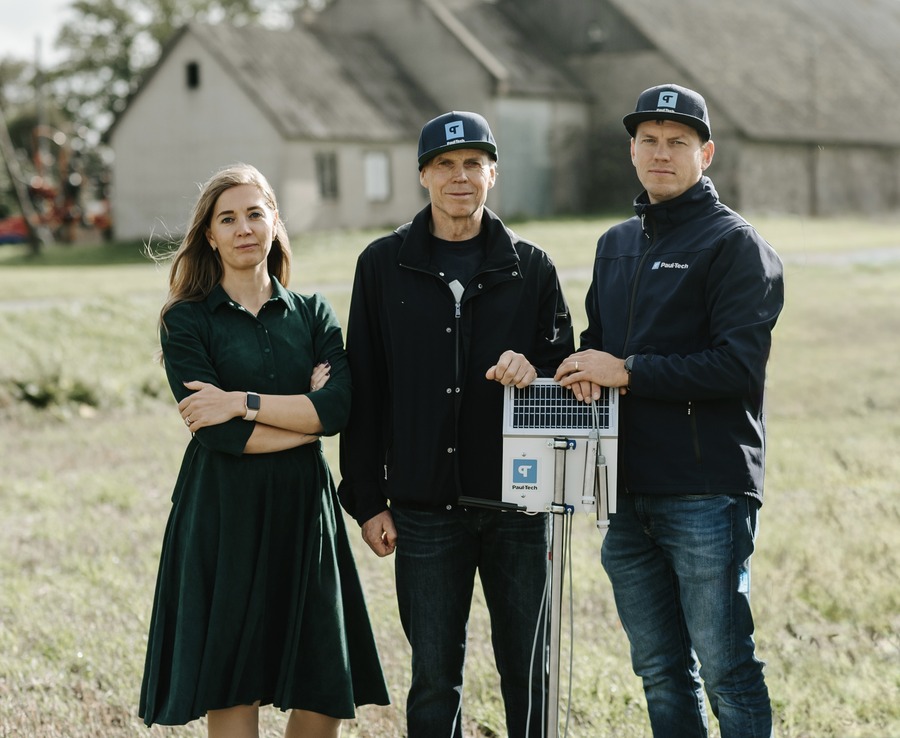
Paul-Tech is a family company born from three generations of scientific research and grown together with farmers. Our roots run deep in electronics and soil science, and from the very beginning our mission has been clear: to bring scientific soil data into practical use and help farmers make better decisions in everyday agriculture.
Paul-Tech was not created from a business plan or a trend. It has grown over time–from real needs and from a strong belief that agriculture deserves better data, clearer insights and a more sustainable future.
From an Idea to a Company
Paul-Tech’s founders, Eve and Mikk Plakk, met in 2014. A few years later, while starting a family and preparing to build their own home, they temporarily moved in with Mikk’s father, scientist Tiit Plakk. It was during this period that the discussions leading to the birth of Paul-Tech began.
In his workspace, Tiit was researching the electrical properties of soil, explaining how these indicators can be used to assess nutrient behaviour and fertiliser dynamics in the soil. Eve, with an engineering background and roots in the agricultural region of Haanja in Võrumaa, immediately recognised the practical value of this technology for farmers. Her father and brother are farmers, and the everyday challenges of working with soil were personally familiar to her.
In 2018, the decision matured: this science-based technology needed to be brought to real fields and into the service of real farming decisions.
A Scientific Foundation Built Across Generations
This decision was built on decades of scientific work. Electronics engineer and scientist Paul Plakk conducted the first foundational research into soil and the processes taking place within it. He was one of the pioneers of higher education in electronics and radio engineering in Estonia. His research focused on the electrical measurement of non-electrical quantities, electrode properties and soil electrical phenomena–knowledge that still forms the foundation of Paul-Tech’s technology today.
His work was continued and further developed by his son, Tiit Plakk, who took the research to a new level and helped translate scientific knowledge into practical applications. As early as the 1980s, sensors and transmitter systems developed by Tiit were already being used in various scientific projects and studies.
The turning point came when Eve saw the opportunity to apply this science more broadly in agriculture. The idea was simple and clear: give farmers the ability to monitor fertiliser dissolution and soil conditions in real time.
A Platform That Speaks a Farmer’s Language
The technology existed–but what was missing was a platform that could make complex data understandable. Eve took responsibility for building the product, drawing on her previous experience as a project manager and product owner in the IT sector. From the very beginning, the goal was clear: data must be real-time, visual and understandable for farmers.
The first versions were still too technical–not just complex, but completely foreign to farmers. From this came a core Paul-Tech principle that remains true today: everything we develop must be validated together with farmers.
First Steps and Maamess 2019
In April 2019, Paul-Tech officially launched its soil station and platform at Maamess, Estonia’s largest agricultural fair. The company was registered, and Paul-Tech was selected as one of the fair’s highlights. It was the first time the technology was introduced to the public.
At that time, no one at Paul-Tech was working full-time on the company. Everything was built in the evenings, alongside other work, funded from personal savings. Interest was high, but trust was cautious. Still, the first farmers were willing to install soil stations on their fields and start following the data.
From Data to Decisions
Over the years, one thing became clear: agriculture’s biggest challenge is not a lack of data, but understanding and applying it. The core value of the Paul-Tech platform lies in translating data into practical decisions.
Today, Paul-Tech helps farmers understand in real time:
- when fertilisers begin to dissolve in the soil,
- when nutrient levels start to decline,
- when soil moisture causes plant stress,
- when spraying becomes risky.
These insights are delivered through visual graphs and email notifications, with hundreds of recommendations developed and refined over time.
NO₃-N – Making the Impossible Possible
One of the earliest questions from farmers was: “How many kilograms of NO₃ per hectare are in the soil?” For a long time, this was considered impossible to measure in real time.
Today, the Paul-Tech platform includes an NO₃-N graph based on the behaviour of anions and cations in the soil solution, reflecting nitrogen levels resulting from both fertilisation and natural processes. This is only the first version, but it represents a significant scientific and practical breakthrough.
Today and the Road Ahead
Paul-Tech has expanded from Estonia to Finland, and since 2024 to the United Kingdom, which has become the company’s main market. Today, our solutions are also used in Lithuania, Latvia, Italy, Ireland and the Netherlands. Soil stations have been operating on farms for years, and partnerships have grown step by step–through trust and practical experience.
Our current focus is on scaling, advanced data analysis and an AI-driven future–AI Paul–which will support farmers in making decisions based on real soil data.
Why We Do This
Paul-Tech was not created for quick profit. It is a family legacy with a purpose: to carry scientific knowledge forward, support farmers and make food production more sustainable. The journey has not been easy–and it will not be. But it is real, meaningful and impactful.
And that is what makes Paul-Tech different.