
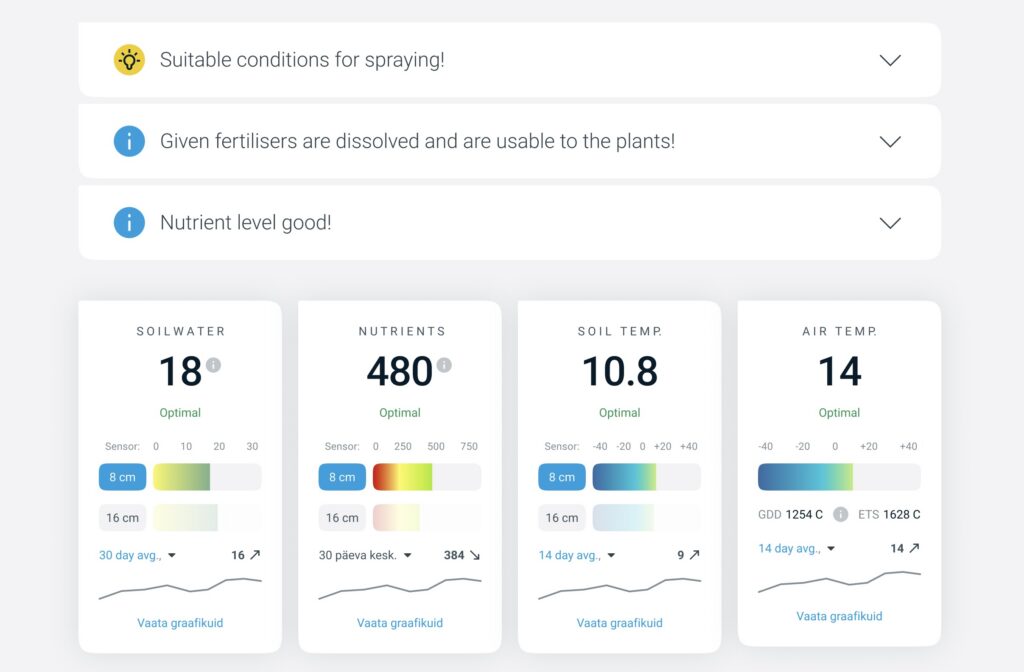
The recommendations displayed in the detailed view of the Paul-Tech dashboard help interpret data and support day-to-day decision-making at the right time. They do not simply show measured values, but provide a clear indication of when carrying out field operations is effective and when it is better to wait.
The outcome of many field operations depends not only on daytime conditions, but also on night-time temperature, rainfall and soil moisture. For example, the effectiveness of fertiliser in the soil or crop protection measures may only develop once conditions are suitable. The recommendations help make sense of these relationships without the need to analyse every parameter individually.
The recommendations are based on real-time measurements from the soil station and reflect actual field conditions – not general weather forecasts or regional averages. This ensures that decisions are made according to the condition of each specific field.
Recommendations support decisions, not actions
Paul-Tech recommendations do not tell farmers what they must do. Instead, they help assess whether taking action at a given moment is sensible or whether it is wiser to wait. Often, the greatest value lies in informed waiting – until fertiliser becomes available to plants in the soil or weather conditions allow effective crop protection.
Making decisions at the right time helps save fuel, fertiliser and working time, while also reducing stress on the crop.
What decisions do the recommendations support?
The recommendations cover the main field operations and crop-related situations, including:
Soil cultivation – whether soil moisture conditions are suitable or whether the soil is too soft, helping to avoid compaction and structural damage;
Spraying – whether wind, temperature and humidity conditions are safe or whether there is a risk of reduced effectiveness. For example, night-time temperatures below 5 °C, high wind speeds or heat stress may indicate that operations should be postponed;
Fertilisation – information on when previously applied fertiliser begins to break down in the soil and become available to plants, helping to understand when the fertiliser effect actually starts;
Crop stress – whether soil moisture, temperature or heat may place excessive stress on the crop;
Nutrient management – messages such as “Agro status good, nutrients sufficient” or “Unused nutrients present in the soil” help determine fertiliser rates and plan subsequent operations.
The number of recommendations in the system is continuously increasing – there are already around one hundred recommendations covering different operations and situations.
How to use the recommendations
Each recommendation is visible in the detailed dashboard view and can be opened to see additional explanations. For example, users can see which indicator has reached an optimal range or which threshold has been exceeded.
Recommendations can also be delivered as email notifications, ensuring that important information reaches the user even when the Paul-Tech platform is not actively being viewed. This enables timely responses, rather than reacting only once the effects are already visible in the field.
Why the recommendations create real value
The recommendations have been developed in close collaboration with users and are based on real field experience. Farmers have reported that timely recommendations have helped them to:
- avoid ineffective operations;
- save fuel, time and input costs;
- reduce stress on crops;
- improve the timing of operations throughout the season.
The result is not simply more data, but clearer decisions and lower risk. Customer experience shows that the greatest economic benefit is achieved when decisions are made based on actual soil conditions rather than fixed calendar dates – saving fertiliser, fuel and time while maximising yield and reducing crop stress.
Summary
Smart recommendations turn complex data into practical guidance. Real-time information collected directly from the field helps identify when conditions support operations and when it is better to wait. This enables informed decision-making throughout the growing season and improves operational efficiency without the need to spend excessive time analysing data.
Read also: Graph View – Understanding Your Field’s Real Behaviour Over Time