
Three seasons of winter wheat data show that applying the maximum fertiliser rate does not guarantee the maximum yield every year
In winter wheat production, nitrogen (N) is one of the most important drivers of yield. However, three seasons of on-farm field data show that even an intensive fertiliser strategy cannot always compensate for unfavourable growing conditions.
A Paul-Tech analysis based on data from 73 winter wheat fields across three different seasons reveals a clear pattern: nitrogen creates yield potential, but whether that potential is realised depends largely on in-season weather conditions and broader environmental conditions.
Data from three seasons
The analysis covered fields where the nitrogen rate ranged from 100–230 kg/ha (most commonly 120–170 kg/ha).
An agronomic model was used to estimate each field’s maximum yield potential under ideal conditions. The average predicted potential ranged from 8.8 to 9.6 t/ha.
The agronomic yield potential model is designed to estimate maximum yield under optimal conditions, but it does not account for the dynamic in-season weather risk.
Actual yields varied substantially between seasons:
- 2021/22 – the best year for yield realisation
- 2022/23 – a moderate year
- 2024/25 – a season with environmental constraints
The more challenging the season, the larger the proportion of potential that remained unrealised. In a poor year, realised yield could be several tonnes per hectare below the theoretical maximum.
Season 2021/22 – the best year for yield realisation
- Average actual yield: 6.43 t/ha
- Average forecast: 9.26 t/ha
- Yield gap: –2.83 t/ha
This was the strongest season in the analysis. Although the forecast still overestimated performance, the gap was smaller than in the other years. This suggests that environmental conditions allowed a larger proportion of yield potential to be realised.
Season 2022/23 – a moderate year, a larger gap
- Average actual yield: 5.18 t/ha
- Average forecast: 8.37 t/ha
- Yield gap: –3.19 t/ha
Even though nitrogen rates were similar to the previous season, yield was clearly lower. This shows very directly:
The same fertiliser strategy does not deliver the same outcome in different years.
Season 2024/25 – the largest divergence
- Average actual yield: 4.97 t/ha
- Average forecast: 9.46 t/ha
- Yield gap: –4.49 t/ha
The predicted yield was even higher than in previous years, yet the actual yield was the lowest. This points to strong environmental limitations, such as moisture stress during critical growth stages or an unfavourable grain-fill period.
Key conclusion:
A high nitrogen rate did not compensate for an adverse season.
Three-season pattern
| Season | Actual yield (t/ha) | Forecast (t/ha) | Gap (t/ha) |
| 2021/22 | 6.43 | 9.26 | –2.83 |
| 2022/23 | 5.18 | 8.37 | –3.19 |
| 2024/25 | 4.97 | 9.46 | –4.49 |
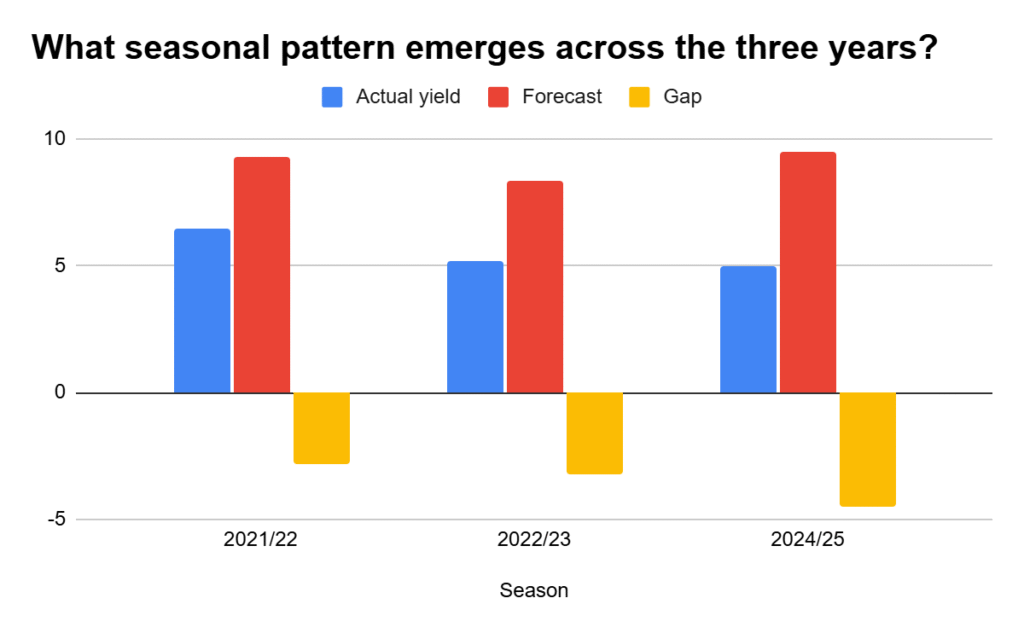
The poorer the season, the smaller the proportion of the calculated potential that is realised. This means fertiliser strategies are often built around “best-year logic”, but farming does not take place under ideal conditions every year.
Eve Plakk, Paul-Tech co-founder and Head of Product, comments on the background to the analysis: “Each season, when speaking with farmers, the question comes up: with the inputs applied, will the forecast yield actually be realised in the field? Analysis of three seasons of data shows that chasing maximum yield every year using a single fertiliser logic is not optimal, because year-to-year weather variability influences outcomes more than increasing the nitrogen rate. While the weather cannot be changed, management decisions can be adjusted to match seasonal conditions and risks.”
Was nitrogen actually the yield-limiting factor?
Based on the data:
- high N rates did not guarantee high yield
- seasonal variability affected results more than total nitrogen applied
- forecasts were in a similar range each year (8.8–9.6 t/ha)
This indicates that nitrogen was not the primary limiting factor. The environment set the ceiling.
Nitrogen remains a fundamental yield factor—but only when weather and soil conditions allow that potential to be expressed.
In a poor year, yield realisation can fall well below potential.
What does this mean for fertiliser decisions?
The data point to a need for:
- a dynamic nitrogen strategy
- in-season, adaptive fertiliser applications
- more explicit consideration of weather risk
- assessing the probability of yield realisation
This level of variability highlights the importance of data-driven management decisions that account for seasonal dynamics, rather than relying solely on a fixed nitrogen rate.
Final conclusion
Three seasons of data show clearly:
Applying the maximum nitrogen rate does not guarantee maximum yield—especially not every year.
Farming is not only about maximising production. It is about making informed decisions under uncertainty.
And perhaps the most important question is not:
“How much can the field produce?”
But:
“How much will this season realistically allow—and how can we manage it wisely?”