

Post author: Farmer Tõnis. Original post published here
This post was prepared in collaboration with Paul-Tech.
Let’s be honest – the vast majority of farmers are interested in yield. In better times, the main concern was yield and not so much the costs; today, the concern is yield and how to achieve it as cost-effectively as possible.
Yield potential can be influenced significantly by timely nutrient applications, especially nitrogen, because it increases leaf area and photosynthesis. Until now, I have relied on gut feeling, standard fertiliser recommendation tables, and the variety’s yield potential when applying nitrogen.
But the question remained: how long does it take for nitrogen fertiliser to become available to the crop, how do plants use it, and is there a risk of leaching?
The 24-hour myth and the real timeframe
After the first spring nitrogen applications to winter wheat, I realised that the story about “you can see the crop turning greener after 24 hours” is about as believable as a psychic challenge.
The 2024/25 season was one with very good growing conditions (at least at the beginning): not too warm and with plenty of rainfall. Logically, the crop should have turned greener the moment I had spread the last hopper-load of nitrogen.
True, the plants did become greener fairly quickly, but that was more likely a combination of temperature, sunshine, the crop “waking up”, and the farmer’s own belief.
In reality, the nitrogen I applied only became available to the crop 5–6 days after application. Even under ideal conditions, it takes time for fertiliser to become “plant-available”.
For me, the important thing was that I could actually see the nutrient graph moving upwards – in other words, that the “money” I am spreading is genuinely reaching the soil.
What the graph showed: rise, fall and uptake
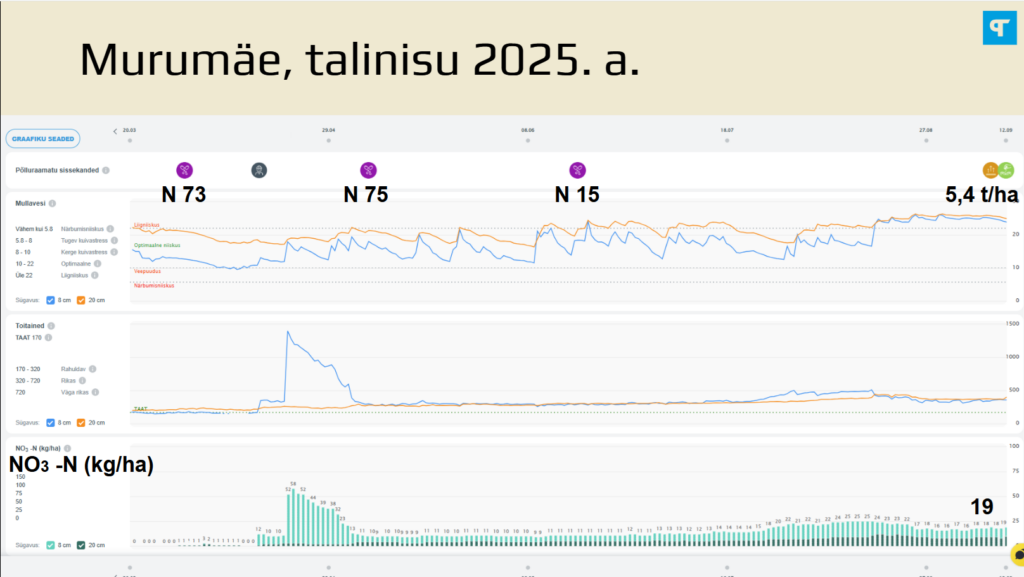
The graph moved upwards, but immediately also began to decline – the crop had started using the nitrogen. That was also the point at which it became visible that the crop stand was becoming denser and greener.
Because the wheat plants were growing vigorously, the nitrogen disappeared from the soil quickly. For example, in the Murumäe field, 74 kg N had been “eaten up” within two weeks. The next 75 kg no longer increased the graph, but nor did it lower it.
Why?
- At the time of the first application, the plants were smaller and still “sleepy” – uptake was slow at first.
- By the time of the second application, growth was already in full swing – everything that was applied was, in effect, consumed immediately.
Does spring-applied nitrogen leach?
A lot of water + a proper amount of nitrogen = leaching? It would be particularly painful if the fertiliser were washed into the lower soil layers (where plants can no longer access it) and from there onwards into groundwater.
The good news: with the spring fertiliser applications, I did not notice leaching, at least not in the Murumäe field.
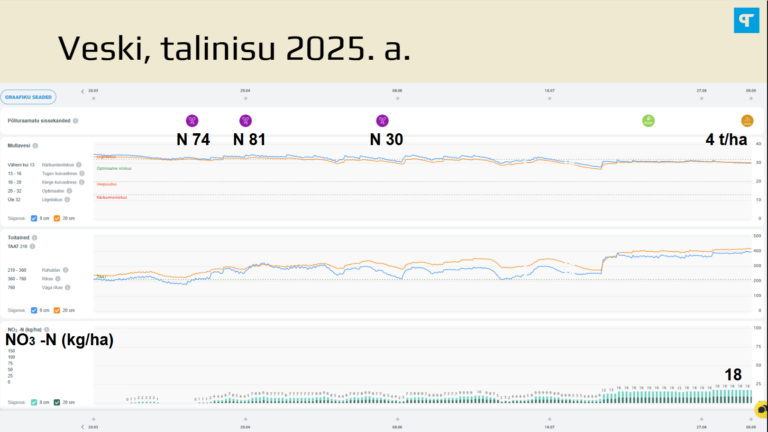
In the Veski field, it could be seen that the sensors positioned at 8 cm and 20 cm depth responded similarly to the fertiliser applications – the graphs moved in the same rhythm. Here I can only theorise that there was so much water in the soil that the fertiliser also moved down more quickly and did not remain “held” in the root zone.
A clear example of leaching: Oonurme (2025/26 winter wheat)
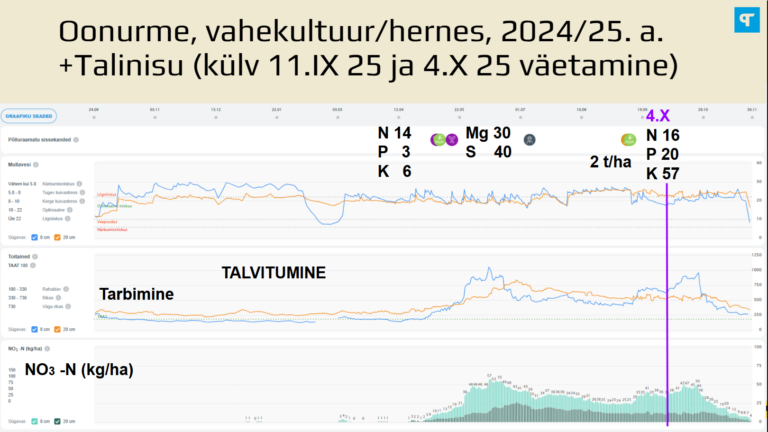
But I saw nutrient washout into the lower soil layers very clearly in the Oonurme field (2025/26 season).
As a trial, I top-dressed an NPK fertiliser (16 kg N) when the plants were at the three-leaf stage. The nutrient graph started rising strongly and reached a value of 958 at 8 cm.
Then more than 26 mm of rain fell in a single day and the graph dropped by 400 points.
The likely reason:
- A large amount of rainfall on soil already close to the limit of excess moisture.
- The soil was unable to retain the nutrients.
- Low temperatures and slow growth.
- There was insufficient crop biomass to take up the nitrogen quickly.
Where did I hope to make savings?
These are difficult times in agriculture – grain prices are too low and costs are too high. In crop production, fertilisers make up the lion’s share of direct costs (fertiliser, crop protection, seed), so any savings achieved there are economically very important.
I had hoped to use soil sensors to reduce nitrogen fertiliser costs, but in the 2024/25 season it did not quite work out as I had expected. I could see nutrients entering the soil and their uptake, but “no matter how much I applied, it was all eaten up”.
The benefit came instead with the following crop. Previously, it was possible to calculate roughly how much nitrogen might still remain in the soil after harvest, but as the Oonurme example shows, nutrients can also disappear quickly.
Protein fertilisation and the “extra pass”
In the 2024/25 season, I applied a further c. 20 kg N at flag leaf stage, because all the signs pointed to a strong yield and the price premium for milling wheat over feed wheat looked promising.
The nutrient graph neither rose nor fell for 40 days. By all assumptions, the applied nitrogen appeared to have been taken up. But before the grain ripened, the graph started rising again, and I realised that the final nitrogen application may have been excessive.
What might have happened:
- Reduced crop demand for N.
- Late nitrification.
- Mineralisation of organic N.
For protein fertilisation I used YaraBela Axan 27+4S, in which ammonium and nitrate nitrogen are present in a 50/50 ratio. My conclusion: part of the more slowly acting ammonium nitrogen was converted into nitrate at a point when the crop was no longer taking it up sufficiently. In addition, root decomposition may also have played a role, giving the graph a slight extra lift.
A practical decision: no nitrogen was needed for straw breakdown
Fortunately, that nitrogen did not disappear anywhere after harvest, and with the following crop in mind I was able to decide that I did not need to apply nitrogen fertiliser in the seedbed. Looking at the graph, the nutrient level returned to the pre-fertilisation level on 24 December 2025 – so, in my view, the decision was the right one.
At this point, I want to make it clear that not fertilising at all (especially in the case of major nutrients) is certainly not sustainable in the long term, and seasons differ greatly. In the case of the Oonurme field, the surface-applied nitrogen disappeared after heavy rain, and it is not going to come back.
Soil analyses show that phosphorus and potassium levels are good. To get through difficult times, I am “borrowing from the soil” and in better times I will put it back. Since triticale was planted after winter wheat in the Murumäe field, the rule of thumb would suggest applying 10 kg N per tonne of yield/straw; in my case 50 kg N. Even so, I made the decision to omit it with confidence, because the nitrogen needed for straw breakdown and for the triticale’s establishment was already present in the soil.
FAQ: nitrogen in the soil and the risk of leaching
How quickly does nitrogen in granular fertiliser become available to the crop?
In practice, a visible change based on the sensor reading may only appear after several days. In my experience, this was around 5–6 days after application, even under good conditions.
Why does the crop not turn green “within 24 hours”?
A visible greening effect may result from temperature, sunshine and the start of active crop growth, rather than necessarily from the rapid uptake of fertiliser.
When is the risk of leaching greatest?
If the soil is already excessively wet, a large amount of rainfall arrives at once, and crop growth is slow (cold conditions, low biomass), then the risk increases that nitrogen will move below the root zone. In other words: very likely in autumn.