
What is the Woodgarston Trials Programme?
The Woodgarston trials programme is a long-running catchment initiative run by South East Water, focused on understanding when, where and why nitrate losses occur, and how they can be reduced while maintaining productive farming systems.
Working directly with farmers, advisors and technical partners, the programme compares land use and in-field mitigation approaches across a chalk groundwater catchment. The aim is not only to measure nitrate in water, but to understand the soil and crop processes that drive those outcomes. This allows solutions to be targeted, practical and proportionate.
Why does soil insight matter for water quality?
Water monitoring tells an important story, but often after the key decisions have already been made in the field. By the time nitrate appears at depth or in groundwater, the conditions that caused it may be weeks, months or even years in the past.
To strengthen the interpretation of results and improve future trial design, the programme brought in continuous soil monitoring, adding insight into what is happening below the surface, in real time.
What role did Paul-Tech play in the programme?
Paul-Tech joined the trials as a monitoring and analysis partner, working alongside established delivery partners to support interpretation and learning.
- Year 1: 10 Paul-Tech soil stations were installed across trial sites
- Year 2: expansion to 16 stations for 2025–26 monitoring, increasing coverage across soils and land uses
Steering Group discussions identified Paul-Tech as a key partner in the current programme, with collaboration expected to continue as trials evolve and new projects are developed.
What did the added soil data reveal?
Paul-Tech stations track nitrate movement alongside soil moisture, temperature and weather conditions, helping the programme see when soils shift from holding nutrients to transporting them downwards.
This makes it possible to identify high-risk periods, such as wet recharge events following nitrate release, while understanding why losses occur under some conditions but not others.
Fertiliser timing and rates matter, but they are only part of the story.
Nitrogen must first become plant-available nitrate, whether from applied fertiliser or the breakdown of organic matter and crop residues. This conversion is driven by biological activity and can take weeks or months, depending on soil temperature and moisture.
By viewing nitrate availability alongside crop growth stage and demand, the programme distinguishes between nutrients likely to be absorbed and those that become available too early. This early availability increases the risk of leaching, especially if heavy rainfall follows.
This perspective helps shift the conversation from what was applied to when nutrients actually become available and needed.
How do soil signals connect to water outcomes?
Year 1 of the programme brought together multiple evidence streams:
- Paul-Tech soil data showing near-surface nutrient behaviour
- Porous pot measurements at depth
- Wider South East Water analysis of nitrate trends
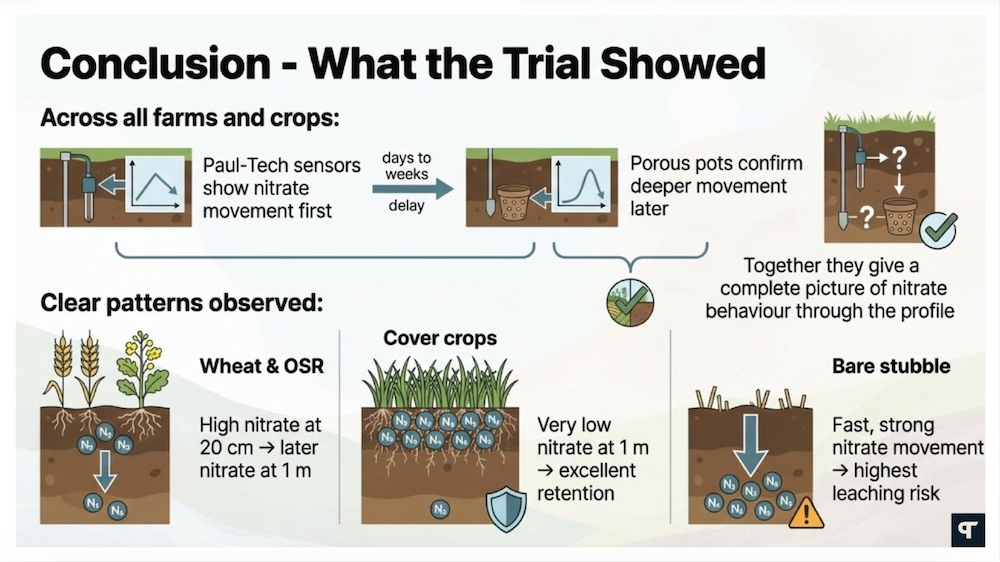
Together, these datasets show a consistent pattern: changes observed in the soil are often reflected later in porous pots and water indicators, providing confidence in the interpretation of risk periods and mitigation effects.
Rather than replacing existing monitoring, the soil data adds context and timing, helping explain why water results look the way they do.
What did the trials show about nitrate risk?
Across sites and seasons, the combined analysis highlighted clear and repeatable patterns:
- Cover crops consistently showed the lowest nitrate losses
- Bare soils and stubbles were higher-risk, particularly during wet periods
- Winter wheat showed higher losses in winter, underlining the importance of autumn and early-season management
- Rainfall and recharge events are the main drivers of nitrate movement, not single actions in isolation
These findings reinforce practical mitigation approaches while helping prioritise when and where effort is most effective.
Why does this matter for you as a farmer?
For farmers, the trials demonstrate how a better understanding of soil processes can:
- reduce avoidable nutrient losses
- improve confidence around timing decisions
- support efficient nutrient use aligned with crop demand
- lower risk during vulnerable periods without increasing paperwork or complexity
The focus is insight, helping decisions work with the soil and crop system rather than against it.
Over time, this approach can support the practical goal most growers share: the same or better yields with less wasted fertiliser. Using cover crops, natural nitrification processes and well-timed applications, nutrient supply can be better matched to crop demand, improving profitability while reducing unnecessary passes, labour, machinery time and compaction, and lowering losses to the wider environment.
What does the future hold for the Woodgarston programme?
With monitoring expanding into Year 2, the Woodgarston trials programme is building a stronger evidence base for mitigation strategies that are both effective and workable on farm.
Paul-Tech will continue supporting the programme by providing real-time insight into soil and nutrient dynamics, helping ensure future trial work captures not only what appears in water, but the processes that drive those outcomes.
About Paul-Tech
Paul-Tech provides in-field soil monitoring that translates soil, weather and satellite data into practical insight. The system supports farmers, advisors and environmental programmes by showing what’s happening below the surface, in real time.
About South East Water
South East Water supplies top-quality drinking water to 2.3 million customers across the south east of England. Our teams work hard to keep taps flowing across parts of Hampshire, Berkshire, Surrey, Sussex and Kent. Through a network of 9,000 miles of pipe, we deliver 543 million litres of water every day.
To supply our customers, we draw water from more than 250 boreholes, six rivers and six reservoirs. This water is treated at one of our 88 treatment works.
We carry out almost two million water quality tests a year at our state-of-the-art laboratory in Hampshire, on up to 1,000 different water samples taken daily from treatment works, storage reservoirs, customers’ own taps and other commercial activities.
Our customers rely on a secure supply of our natural resource – water. That’s why we see our role as guardians of the environment.
For further information, please visit https://www.southeastwater.co.uk/