
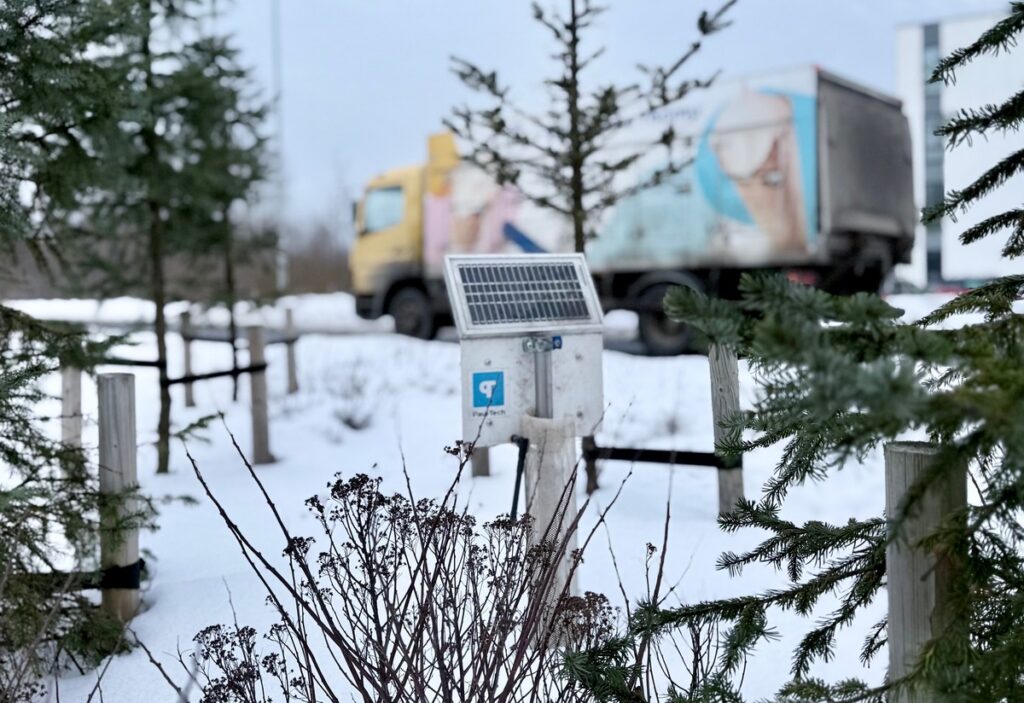
During winter, the growing conditions for urban trees are often far more challenging than they may appear at first glance. One of the most significant yet invisible stress factors is soil salinity, which can damage tree root systems and inhibit growth. This is why it is essential to understand how salinity develops and why measuring it helps identify risks earlier and prevent damage more effectively.
What Is Electrically Measured Salinity?
Soil salinity is most commonly assessed through electrical conductivity (EC). Simply put, a soil sensor measures how well the soil water solution conducts electricity. The more dissolved ions—such as salts—present in the soil water, the better it conducts electricity and the higher the measured salinity value.
It is important to emphasise that this measurement reflects the overall salt concentration in the soil, regardless of its origin. Possible sources include:
- winter road maintenance and meltwater,
- fertilisers,
- the soil’s natural mineral content,
- construction-related and urban environmental impacts.
For this reason, salinity data must always be interpreted in the context of surrounding conditions, which may either amplify or offset one another.
Why Does Salinity Increase Especially Fast in Urban Areas?
Urban environments differ significantly from natural growing sites, particularly in terms of water movement. Many planting areas are surrounded by paving, asphalt, or other impermeable surfaces that direct rainwater and meltwater into specific collection points.
When this water reaches the tree’s root zone, it often carries dissolved substances with it—including salts. As a result, planting areas can begin to function like collection basins during winter: water accumulates but cannot drain or leach away quickly enough.
The Accumulation Effect: Why Can Salinity Rise Rapidly?
Salinity does not always increase gradually. In some urban planting sites, levels can rise very quickly, especially during thawing periods and rainfall events. This is caused by the so-called accumulation effect, where water collects dissolved salts from surrounding surfaces and transports them directly into the root zone.
If there are additional barriers beneath or around the planting area—such as compacted soil, dense clay layers, or underground structures—the leaching of salts may be restricted. In such cases, elevated salinity persists for longer periods, increasing the stress on trees.
Frozen Soil Masks the Problem—Until Thawing Begins
During winter, it is also important to consider that salts do not move in frozen soil. They remain bound within frozen ground, snow, and slush, meaning that rising salinity levels may not immediately appear in measurements.
The issue often becomes visible only after the soil begins to thaw. Meltwater then carries accumulated salts into the active soil layer near the roots, where sensors are able to detect them. This is why late-winter and early-spring periods can show sudden spikes that are actually the result of effects building up over time.
Why Is It Important to Monitor These Changes?
The health of urban trees depends heavily on whether their root systems can access sufficient water and oxygen and whether the soil’s chemical environment remains balanced. Elevated salinity can create conditions where trees struggle to absorb water even when the soil appears moist. Over the long term, elevated salinity can reduce growth, damage root systems, and increase the need for maintenance and tree replacement.
This is where innovation plays a key role. Soil monitoring sensors allow changes to be detected early—before trees show visible signs of decline. This makes it possible to:
- assess site-specific risk levels,
- distinguish between temporary and persistent changes,
- make more informed maintenance decisions (e.g. flushing, improving drainage, redesigning planting areas),
- focus resources where they have the greatest impact.
In Conclusion
Winter salinity is not merely a chemical indicator—it reflects how urban environments function as a whole. Water movement, road surfaces, weather conditions, and infrastructure all directly influence the growing conditions of urban trees. Monitoring electrically measured soil salinity provides real-time insight into these processes and supports smarter, more proactive, and more sustainable urban green space management.
Read also: Real-time Soil Monitoring Takes Root in Urban Green Spaces