
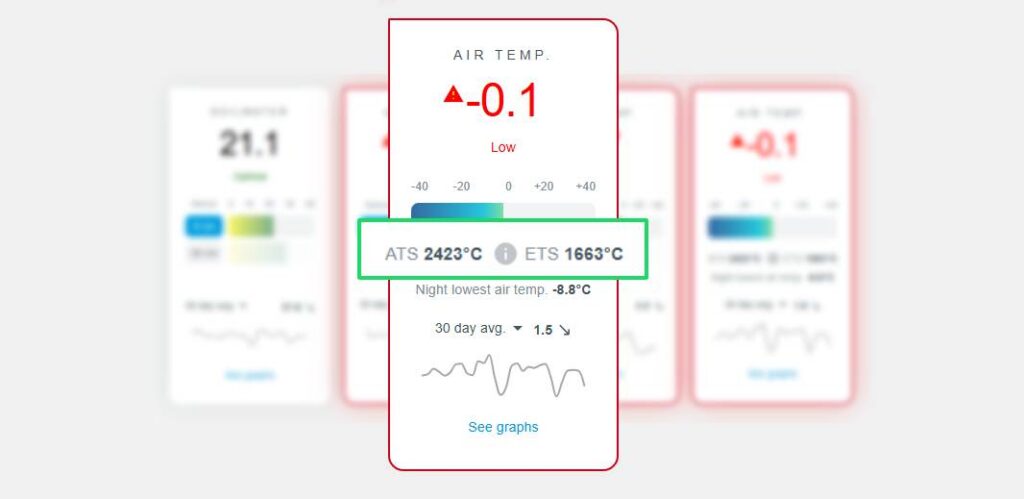
When looking at daily temperatures in the field, conditions may seem suitable for crop growth. However, plants do not grow in a single day – their development depends on the amount of heat accumulated over the entire growing season. To describe this, the active temperature sum (ATS) and the effective temperature sum (ETS) are used.
What Is the Active Temperature Sum (ATS)?
ATS, or active temperature sum, shows how much heat above 10 °C a plant has received during the growing season. It adds together all temperature degrees that exceed the threshold required for plant growth. ATS provides an overview of the total amount of heat available over the season, without considering how much of that heat the plant actually uses.
What Is the Effective Temperature Sum (ETS)?
ETS, or effective temperature sum, takes into account only the portion of temperature that directly supports plant development. In its calculation, a base temperature (for example, 10 °C) is subtracted, meaning that cooler days contribute less and warmer days contribute more.
ETS reflects more accurately how much the plant has actually “grown” during the season and helps assess whether the accumulated heat is sufficient to reach the next stages of development.
Why Are ATS and ETS Important for Your Field?
Monitoring active and effective temperature sums helps to better understand crop development in the field:
- If ATS or ETS is low, it indicates that the plant has not received enough heat and that development may be slower or delayed.
- If ETS increases slowly, it is possible to track whether the crop is falling behind in development and, if necessary, plan actions such as fertilisation or other maintenance activities at a more suitable time.
- When temperature sums are high, it becomes possible to anticipate upcoming development stages, such as flowering or maturity, and plan field operations more effectively.
A Real-Time Overview Based on Soil Station Data
Using data from the Paul-Tech soil station, ATS and ETS values can be viewed in real time for each field. This means there is no need to calculate values manually or remember when warmer periods began – an overview of the heat accumulated for plant development is immediately available.
Temperature sum information helps to plan:
- drilling and fertilisation so that they take place during suitable periods;
- spraying when the crop is in an active growth phase;
- potential risks and delayed development issues before they begin to affect yield.
Summary
ATS and ETS show how crops in your field are actually developing, rather than just how the weather feels at a given moment. This is information that is often missing in field management, but which the Paul-Tech service provides automatically and continuously to support informed decision-making.
Read also 👉 Why Monitor Air Temperature? Real-Time Data for Decision-Making