
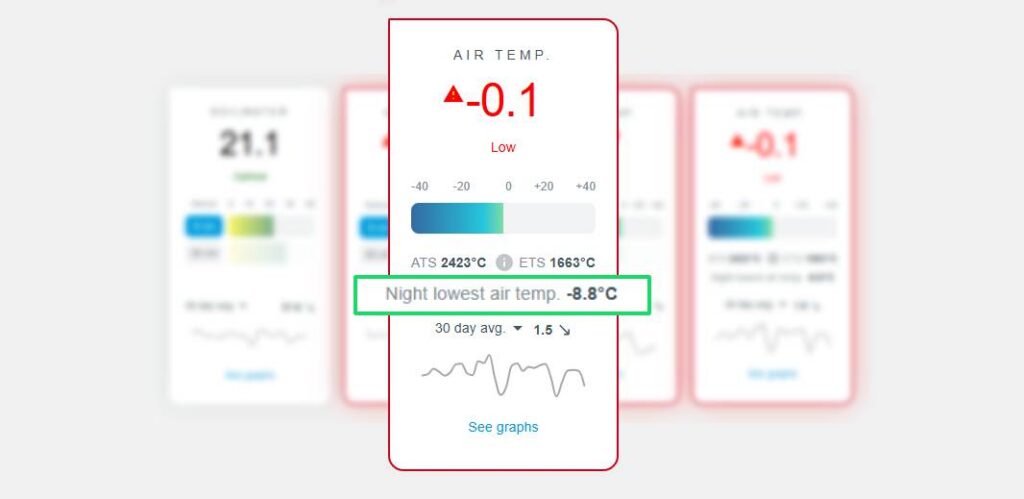
Daytime warmth may appear suitable for crop growth, but the actual condition of the plant is often determined by how cold it gets at night. The night-time minimum temperature shows the level of stress the crop has experienced during the previous night. This helps explain why growth may slow down or why the crop does not respond to field operations as expected.
This cannot be assessed by looking at daily average temperatures alone. A single cold or warm night may not be decisive, but several consecutive cold or warm nights provide a clear signal of the crop’s condition.
Spring – Is the Crop Truly Ready to Grow?
In spring, the night-time minimum temperature helps assess when the crop is genuinely ready for growth and when cold conditions may still be limiting development. Low night-time temperatures reduce root and leaf activity even if daytime temperatures appear suitable.
When temperatures fall close to or below zero, frost damage may occur. This is not always immediately visible but often becomes apparent later through slower growth, weaker development or uneven crop appearance.
Summer – Recovery or Stress?
In summer, the night-time minimum temperature indicates whether the crop is able to recover overnight or whether it is experiencing stress that may slow growth and affect leaf condition.
During heatwaves, the night-time minimum temperature may remain around 20 °C or higher (so-called tropical nights). In these conditions, the crop does not cool sufficiently, respiration and water loss continue overnight, and heat and water stress increase. Growth may slow, and the crop becomes more sensitive to water shortage and spraying, even if daytime conditions seem suitable.
Autumn – The End of Active Growth and Preparation for Winter
In autumn, night-time temperatures often drop faster than daytime temperatures. Consistently cooler nights indicate when active growth is coming to an end and when the effect of field operations may become weaker.
For winter crops, monitoring canopy temperature in autumn helps assess whether the crop remains in a calm overwintering phase or has begun growing too actively, which may increase the risk of damage during winter. This helps avoid late decisions that no longer support crop development and ensures winter crops enter winter at the correct growth stage.
How Different Night-Time Temperatures Affect the Crop
Cold Nights and Frost
When the night-time minimum temperature drops very low or close to zero:
- the risk of frost damage increases;
- root and leaf activity decreases;
- the crop may appear vigorous during the day but is actually under stress.
Under such conditions, fertilisation and spraying may be less effective or place additional stress on the crop.
Optimal Night-Time Temperatures
When the night-time minimum temperature remains within a moderate range (for example, around 10–15 °C in summer):
- the crop is able to recover overnight from daytime heat and intensive growth;
- root and leaf activity continues steadily;
- the crop is more responsive to fertilisation and other field operations.
These are the conditions in which the crop makes the best use of the heat accumulated during the day.
What This Information Helps You Do
Monitoring the night-time minimum temperature helps to:
- assess frost risk in spring and summer, even when damage is not visible during the day;
- understand growth slowdowns at different times of the season, as cold nights reduce crop activity and warm nights increase stress;
- plan fertilisation, taking into account whether the crop can absorb nutrients efficiently;
- plan spraying, knowing whether the crop has recovered from night-time stress or needs more time;
- prevent risks at different stages of the season.
Why Field-Level Temperature Measurements Are More Important Than Weather Forecasts
Weather forecasts and national weather stations usually measure temperature at around two metres above ground level. In reality, temperature at crop height can be significantly different – especially on clear and calm nights, in low-lying areas, on peat soils or in open fields.
The Paul-Tech soil station measures temperature at canopy height, where the crop actually grows and experiences cold. This means you see not a forecast or an average, but the actual temperature on your field, at crop level.
Summary
The night-time minimum temperature provides a clear picture of the crop’s actual condition during the night. In spring, it helps assess when the crop is truly ready to grow and when cold may still limit development. In summer, it shows whether the crop is able to recover overnight or is under stress affecting growth and water use. In autumn, it signals the end of active growth and indicates how well winter crops are prepared for winter.
This information complements daytime temperature data and supports better decision-making when timing fertilisation, spraying and other field operations throughout the growing season.
Read also 👉 Why Monitor Air Temperature? Real-Time Data for Decision-Making