
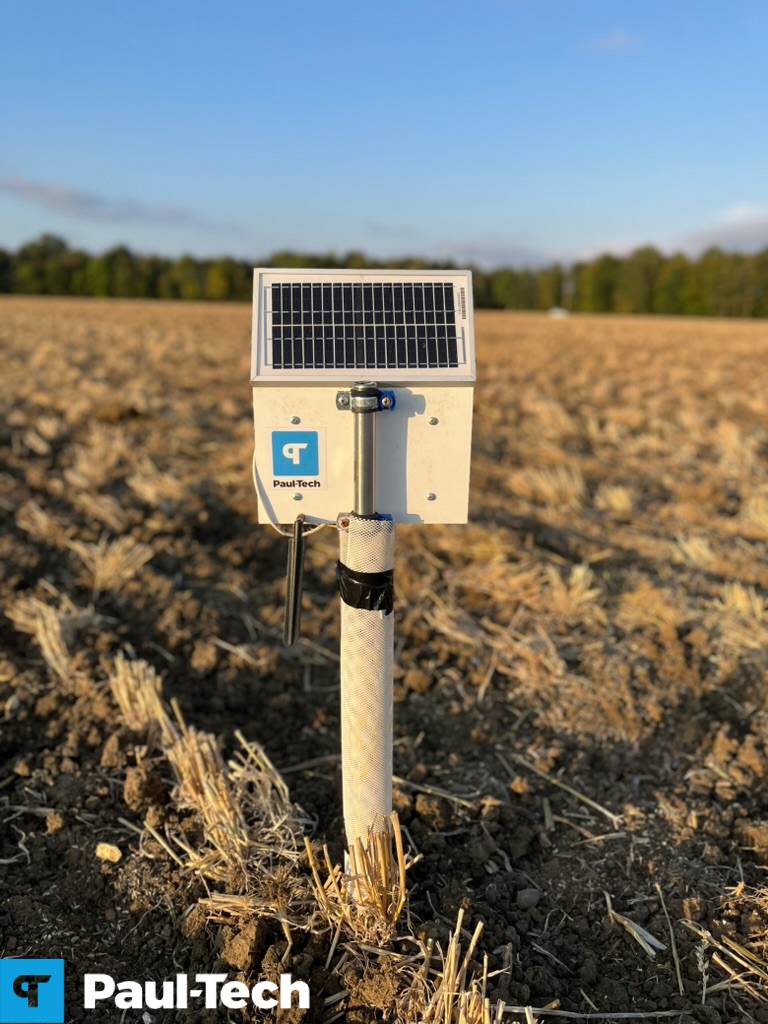
In agriculture, effective measuring devices are not created by chance. They are created when engineering logic, physics and agronomic understanding are aligned – and when that logic is also validated by independent research.
The handheld device Percometer and the stationary Paul-Tech soil station were created by the same engineer and scientist, Tiit Plakk. Both devices are based on the same electrophysical and agronomic measurement principle, developed through decades of research and development.
It is important to emphasise that the stationary Paul-Tech soil station had already been developed before the Percometer-related research carried out at the Estonian University of Life Sciences in 2021. In other words, the measurement principle did not developed from that research, rather, the research provided independent and quantitative confirmation of it.
The research confirmed the accuracy and agronomic relevance of the measurement principle
Under the supervision of professors Alar Astover and Endla Reintam at the Estonian University of Life Sciences, Merko Kärp completed his Master’s thesis:
“Effect of measurement method and fertilisation to soil moisture and electrical conductivity” (2022), which compared different methods for measuring soil electrical conductivity and moisture.
The study analysed three approaches:
- laboratory soil analyses (including electrical parameters of soil solution)
- stationary Y soil sensors
- measurements taken with the Percometer
The aim was to assess which methods best reflect the impact of fertilisation and are suitable for making practical fertiliser decisions.
The effect of fertilisation was most clearly evident in the Percometer measurements
The results were unambiguous.
Soil electrical conductivity measured with the Percometer had the strongest relationship with mineral nitrogen application rates:
- considering all trial variants together, the correlation was r ≈ 0.80
- on plots with mineral fertiliser only, it was as high as r = 0.97
For comparison:
- for laboratory EC measurements, the relationship was approximately r ≈ 0.6
- for readings from stationary Y soil sensors, it was even weaker
This confirmed that the Percometer measurement principle responds most sensitively to fertilisation, reflecting the amount of nutrient salts that reach the soil solution – precisely the part of the fertiliser that is actually available to plants.
The strongest correlation with yield at the right time
The research also analysed the timing of measurements separately.
Late May proved particularly important because, in the case of spring wheat, it is still possible to make in-season decisions about additional fertilisation..
It was during this period that it became clear that:
The soil electrical conductivity measured with the Percometer had the strongest relationship with subsequent yield, outperforming both laboratory analyses and stationary Y sensors.
This clearly showed that the measurement principle:
- does not simply describe “soil”
- but is directly related to plant nutrition and yield formation
Professor Alar Astover summarised the results as follows:
“Measuring electrical conductivity using soil sensors and linking the results to practical fertilisation recommendations is a serious challenge worldwide. However, based on our long-term trials, the sensitivity of Paul-Tech’s sensors for these measurements is very promising and provides additional information for planning fertilisation.”
The stationary Paul-Tech soil station – the same logic, in continuous and spatial measurement
If the Percometer enables a single precise spot measurement, Paul-Tech’s stationary soil station:
- uses the same scientifically validated measurement principle
- extends it to continuous, automatic and uninterrupted monitoring over time
- enables spatial monitoring at up to three measurement points – to assess the movement of water and nutrients and changes in the soil at different depths or distances
If the Percometer asks:
“What is the condition in the soil right now?”
then the soil station asks:
“How does that condition develop, persist and change – over time and in space?”
The time and spatial dimension were the natural limitation of handheld measurement – not the quality of the measurement.
Summary: engineering continuity + scientific confirmation
The Paul-Tech soil station is:
- a solution created by the same engineer
- a logical next step from the Percometer’s measurement principle
- whose accuracy and agronomic relevance were confirmed by independent research
Science confirmed that it works.
And that is exactly how genuinely effective precision agriculture is created.