
The nitrogen was there. The soil just needed rain.
How real-time soil data told the full story of a dry season, and proved a farmer’s decisions were right all along.
Key figures at a glance
- Actual yield: 5.5 t/ha
- Normal expectation: 7.5–8.0 t/ha
- Total N applied: 126.5 kg/ha
- Drought stress duration: 8+ weeks during tillering
- Nutrient level at late June flush: 750+
The setup: a field in good hands going into spring
In November 2024, James Brown drilled a cover crop into a sub-soiled lime-rich loam field using a vaderstad carrier and bio drill. Through winter, the Paul-Tech station captured stable soil moisture and nutrient levels at both 8 cm and 20 cm depth, the cover crop holding the soil structure together through the dormant period.
Come March, the cover crop was sprayed off, mowed, and worked down before spring barley was drilled on 18 March with a Väderstad disc drill. The Paul-Tech graphs show a clear moisture drop around this cultivation window, a normal but measurable cost of working a loam soil in dry conditions.
The nitrogen programme — applied at the right time, for the right reasons
James applied all his nitrogen across four applications between 20 March and 14 April, totalling 126.5 kg N/ha. Each application was timed to crop growth stage and made ahead of forecast rainfall, standard agronomic practice and the correct approach on a clay soil.
20 March — 77 kg N/ha
Mineral application at germination stage (BBCH 00–09). Two days after drilling, timed ahead of expected rain.
10 April — 18 kg N/ha + P
First three leaves (BBCH 10–13). Phosphorus included. Forecast rain expected to follow.
12 April — 31.5 kg N/ha
First three leaves. Continued the programme ahead of forecast rainfall.
14 April — K only (59.76 kg/ha)
Potassium applied separately, good practice to avoid interaction with nitrogen.
The forecast rain after the April applications failed to arrive. This was a weather forecasting failure, not a management one. The nitrogen went on at the right crop stages, for sound agronomic reasons, the soil just didn’t get the moisture it needed to activate it.
In-season decision points: where the data would have created a choice
This is where real-time soil intelligence changes what’s possible. At two moments during the spring programme, the Paul-Tech data was already signalling a problem, before the applications went on.
Decision point 1 — 10 April (N2: 18 kg N/ha + P)
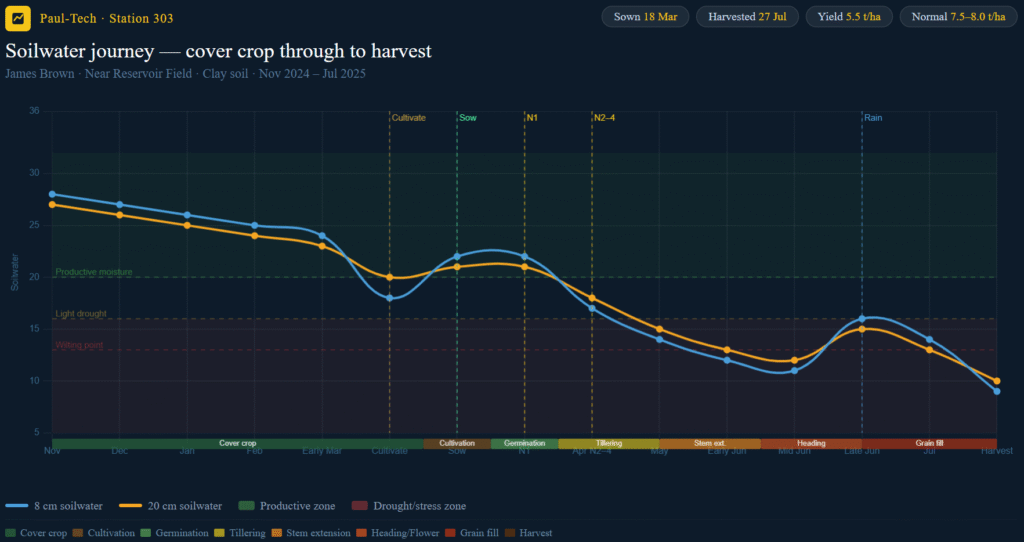
By the time the second application went on, soilwater was already trending downward at both depths. The soil sat at the lower edge of productive moisture, heading towards light drought stress. The Paul-Tech morning report would have flagged this. With the crop still at early leaf stage and nitrogen demand modest, waiting 7–10 days for moisture to recover carried very little yield risk, and the field remained accessible, meaning the option to return with the held-back nitrogen was genuinely available.
What a Paul-Tech user would have seen: Soilwater trending downward at 8 cm and 20 cm. No significant rainfall having materialised. Nutrients flat, no response to the first application yet.
The decision available: Reduce this application or hold it back entirely. Waiting another 7–10 days would have carried very little yield risk at this growth stage and reduced the volume of nitrogen sitting dry in the soil.
Decision point 2 — 12 April (N3: 31.5 kg N/ha)
Two days on, soilwater had fallen further. No rainfall had arrived. Nutrients and NO₃ were completely flat, no response to either previous application. The soil was dry, locked up, and not delivering.
What a Paul-Tech user would have seen: Soilwater now in light drought stress at the shallow depth. Nutrients and NO₃ completely flat despite two applications already in the ground. Availability low and falling.
The decision available: With 95.5 kg N/ha already applied and the crop still at early leaf stage, holding this 31.5 kg N/ha until the soilwater recovered was a low-risk, defensible call. Spring barley’s nitrogen demand at this stage is forgiving enough that a delay of one to two weeks does not cost yield, provided the programme is completed before stem extension. The potential saving: around £38/ha with negligible yield impact.
A choice that didn’t previously exist
James made reasonable decisions based on forecast rain. The point is not that he was wrong, it’s that a Paul-Tech user has an additional layer of information at these moments: a live read on what the soil is actually doing, not just what the forecast suggests. That data, visible in the app each morning, turns a binary decision into an informed one.
And crucially, the same principle applies in any season. In a wet year, the data may show nutrients dissolving rapidly, soil mineralisation adding to what’s already there, or heavy rain moving nitrates below the root zone before the crop can reach them. Every season tells a different story. Having the data means you can read it and respond.
What the data showed: eight weeks of drought during the crop’s most critical window
From mid-April through to late June, soilwater at both sensor depths fell into drought stress, at times approaching wilting point. This covered the entirety of tillering and stem extension, the two stages where spring barley builds its yield potential.
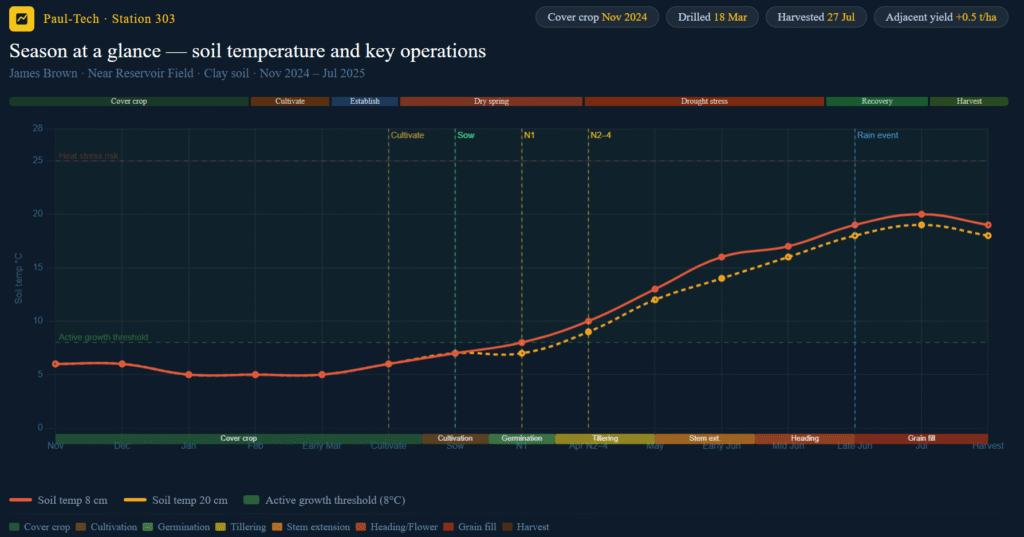
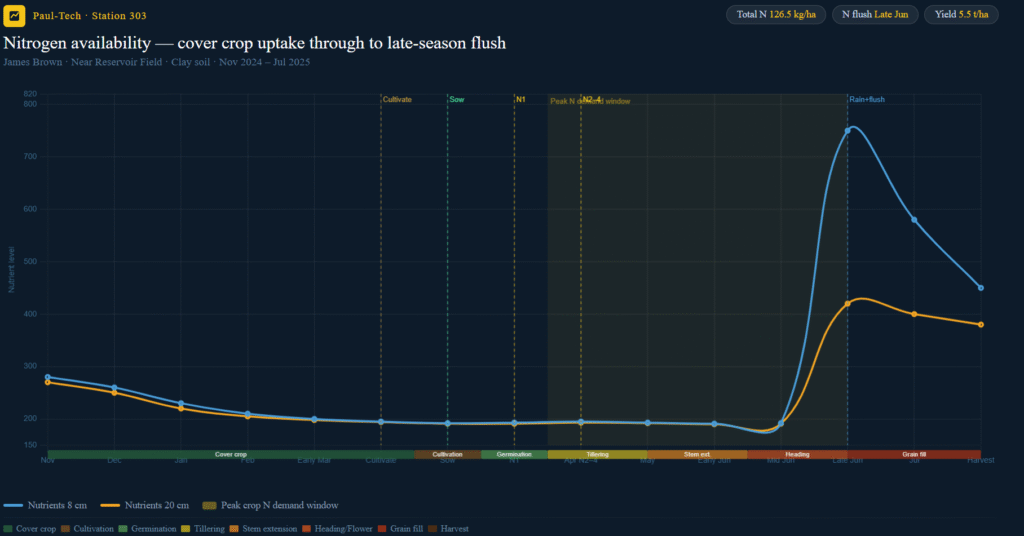
Despite 126.5 kg N/ha having been applied, nutrient and nitrate levels stayed flat and low throughout this period. The nitrogen was in the soil, but it just had no water to dissolve and carry it to the roots. Availability remained suppressed even as soil temperatures climbed into the optimal growth range.
When meaningful rain finally arrived in late June, the Paul-Tech graphs showed a dramatic spike in both nutrient and nitrate levels at the 8 cm depth. This is direct evidence that the nitrogen had been conserved in the soil throughout the entire dry period, waiting for water. The fertiliser programme worked exactly as intended. The weather did not.
The outcome: 5.5 t/ha, a moisture story not a nitrogen story
The crop was harvested on 27 July at 5.5 t/ha, against a normal farm expectation of 7.5–8.0 t/ha. The yield gap of 2.0–2.5 t/ha is almost entirely explained by the moisture deficit during tillering and stem extension.
An adjacent field on the same farm, managed with a less intensive cultivation approach, yielded 6.0 t/ha in identical weather, suggesting that minimising soil disturbance during spring establishment helps protect moisture on loamy soils. Both fields experienced the same dry spring and the same fertiliser programme logic. The difference was in the soil.
At £180/t, the 0.5 t/ha gap between the two fields represents approximately £90/ha in gross revenue, a useful reference point when considering the balance between seedbed preparation and moisture conservation on this soil type.
Data in action: using soil intelligence to time a cover crop spray-off
After harvest, the Paul-Tech station was moved to a new sandy field on a different farm. Residual nitrogen left over from the dry 2024/25 season fed a strong cover crop through autumn 2025. Rather than spraying off on a calendar date, the farmer monitored the nutrient drawdown through the Paul-Tech app.
When the data showed nutrients had been almost entirely taken up by the cover crop, he made the call to spray off, ensuring no large green mass of unprocessed nitrogen remained ahead of drilling for 2026.
No guesswork. No calendar. Just the soil saying the job was done.
What comes next
For 2025/26, two Paul-Tech stations are planned on a split field, one on a heavier cultivated side, one on a lighter sandy side under cover crop. The comparison will reveal how different management approaches affect soil moisture, nutrient availability, and crop performance across contrasting soil types on the same farm.
This season’s data becomes the baseline. The story keeps building.